
Restoring the Tywi River

The Natural Resources Wales’s (NRW) Four Rivers for LIFE project aims to improve the habitat structure and function of four SAC (Special Area of Conservation) Rivers in south Wales; the Teifi, Tywi, Cleddau and Usk.
Across the Tywi River catchment, project officers have completed several schemes as part of efforts to restore the river’s natural structure and improve access for migrating fish.
In this blog, the Four Rivers for LIFE Team explain the importance of the work and future plans.
The Afon (River) Tywi
The River Tywi is one of the longest rivers entirely within Wales, flowing 120km from its source at just over 430m in the Cambrian Mountains to its mouth in Carmarthen Bay.
The steep gradients in the upper catchment throttle flows, often creating plunging gorgy habitat with pool and cascade sequences. As the gradient eases, the river spills out onto its floodplain on the picturesque Tywi valley.
Here, the river develops a meandering form, weaving back and forth across the floodplain, creating a dynamic series of constantly evolving eroding banks and depositional gravel bars.
The fluvial history of the Tywi can be seen on the landscape today, with the floodplain bearing the scars of old river channels and oxbow lakes (the remnants of old meanders).
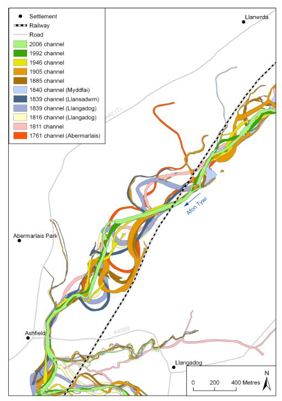
Image: Old river channels on the Tywi River near Llangadog from 1761 to 2006.
Special wildlife along the Tywi River
The Tywi River supports a wide range of wildlife and has been designated a Special Area of Conservation (SAC).
The river once supported huge numbers of Atlantic salmon and sea trout. At the peak of the fishery in the 1970s-early 80s, reported catches averaged over 2,000 and 10,000 fish annually for salmon and sea trout respectively.
Other fish were also abundant, with anecdotal accounts of eel being so numerous that you could actually hear the writhing mass of glass eels and elvers migrating upstream in spring and summer.
The river also supports important populations of sea, river and brook lamprey. Lamprey are jawless fishes that diverged from other vertebrates about 500 million years ago. To put this in perspective, this is before trees existed on earth. In evolutionary terms, humans are more closely related to salmon than salmon are to lamprey!
Other fishes for which the Tywi is designated include the Twaite and Allis shad (very rare freshwater-migratory members of the herring family), as well as bullhead, a small benthic fish which requires clean, well-oxygenated, fast flowing streams.
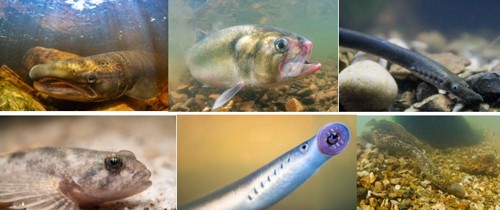
Image: above Left to Right: Atlantic salmon, Allis shad, Brook lamprey, Below Left to Right: Bullhead, River lamprey and Sea lamprey
Apart from fish, the Tywi is one of the best rivers in Wales for otter. Although secretive, if you look carefully, there are signs of otter (e.g. footprints, foraging routes and spraint) on most streams. Otter are dependent on thick vegetation cover on river banks for nesting and breeding, and rely on a plentiful fish prey.
The eroding cliffs in the floodplain provide valuable nesting habitat for sand martins which can be seen feeding on flying insects on still summer evenings. The dipper is an emblematic river bird which wades underwater picking insects off the stream bed and is a key indicator of habitat quality. Other river specialists regularly spotted on the Tywi and tributaries include the kingfisher, grey heron, cormorant, goosander and a range of wildfowl.
Pressures facing the Tywi River
In recent decades, much like many of our other Welsh rivers, the Tywi has seen widespread decline and the SAC is currently in ‘Unfavourable Condition’.
Average salmon and sea trout catches are down at less than 10% of their 1970s numbers and the populations are ‘At Risk’.
There is no site specific assessment for eels but their numbers are thought to have declined by 90%. Population estimates for lamprey aren’t available but all species are classed as ‘Threatened’ or ‘Near Threatened’.
Though probably present at very much reduced numbers compared to their historic abundance, Tywi populations of shad and bullhead are thought to be self-sustaining. While otter numbers are up considerably since hunting was banned in the 1970’s, there has been a decline in recent years.
Multiple factors are responsible for the decline in the ecology of the Tywi including agriculture and land management practices, sewage inputs, barriers to fish migration, physical modifications, overfishing, climate change and invasive species.
The Four Rivers for LIFE aims to address many of these pressures and return the Tywi towards Favourable Condition.
Working with farmers and land owners on the Tywi River
The LIFE project has been working with farmers and land owners in the Tywi River catchment to reduce agricultural pollution and improve riparian habitat.
Buffer zones with thick vegetation help to absorb agricultural runoff before it reaches rivers, thereby reducing fine sediment and nutrient inputs. The project has completed 14 km of fencing on the Tywi so far. By excluding grazing from livestock, the fencing will help natural vegetation re-establish. Preventing livestock access to rivers reduces bank poaching (erosion) and improve water quality. Where necessary, drinking troughs have been added to ensure livestock welfare.
Tree planting has also been undertaken to support regeneration of bankside vegetation, including a mixture of oak, birch, hawthorn, willow, and alder. These trees will provide valuable cover for species such as otter, help shade streams reducing temperature int her summer, and bind the river banks together, reducing soil erosion.
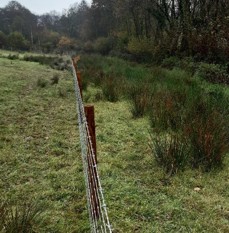
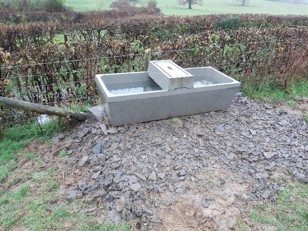
Images above: fencing and water tough at Dyffryn Isaf Farm on the Cothi
Improving ecological connectivity
Barriers to fish migration and ecological connectivity are widely recognised as one of the main causes of the decline the freshwater biodiversity. In recent years NRW has address seven barriers to fish migration on the Tywi River catchment, opening up approximately 40km of river.
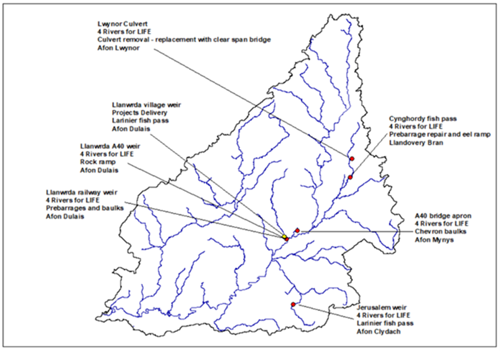
Image: Map of river connectivity work
Afon Lwynor
In October 2025 the LIFE project completed work to remove a culvert on the Afon Lwynor, a tributary of the Llandovery Bran (see before and after images below). The two metre diameter, 12m long culvert pipe restricted the river and disrupted fish movement.
The culvert was replaced with a clear span bridge in order to restore access for all fish species to 4.5 km of habitat upstream and restore natural river dynamics.
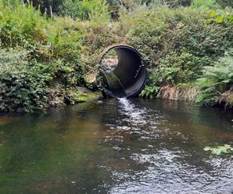
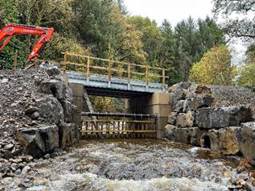
Image: Left to right - Afon Lwynor before and after
Cynghordy fish pass
An existing Larinier fish pass at Pont Wen near Cynghordy had become perched (elevated above water level) and needed some maintenance to the existing prebarrages. In addition, the existing eel pass did not provide adequate conditions for upstream-migrating eel.
The prebarrage was repaired in summer 2025 to provide greater water depth downstream and thereby improve fish access to the base of the Larinier pass. The eel pass was also extended to allow better access to the base of the ramp and an angle iron was added to improve flow conditions.
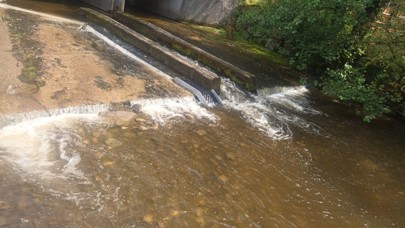
Image: Cynghordy after the work.
Afon Mynys
On the Afon Mynys a concrete apron underneath the A40 road bridge created a significant barrier to fish movements due to shallow fast flows over the smooth surface. Oak beams and chevron baffles (see below before and after images) were installed to concentrate flows towards the centre of the structure, providing depth and low velocity areas for fish to pass up and downstream.
This will facilitate passage of migratory salmon and sea trout, as well as a range of weaker swimming species.
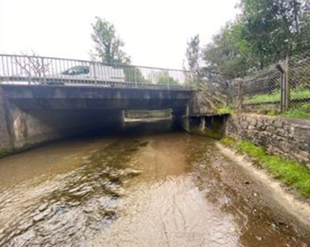
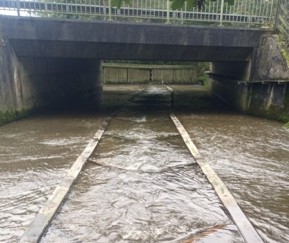
Image: Left to right – Mynys before and after work
Llanwrda village weir
In 2023, NRW’s Salmon for Tomorrow project completed a Larinier fish pass on the Llanwrda village weir.
The combined benefits of this scheme and the two others below and above by the LIFE project, means more than 12km of valuable river habitat was opened up on the Dulais.
Llanwrda road bridge
A weir supporting the A40 road bridge created a significant obstacle to fish on the Dulais. The height of the weir and the fast flows through the existing notch, made it a significant barrier to salmon and sea trout. It was also largely impassable to eel and lamprey under most flow conditions given that, unlike salmon, these species are unable to jump.
In summer 2025, a rock ramp was installed, including a series of four prebarrages (structures to gradually raise the bed and water level) along a 50metre stretch of the river immediately downstream of the weir. Rock and gravel infill was added to create a gradually sloping ramp, effectively eliminating the vertical jump at the weir.
An additional ramp with studded tiles was fitted to the weir at one side to provide an alternative route for weaker swimming fish like eel and lamprey.
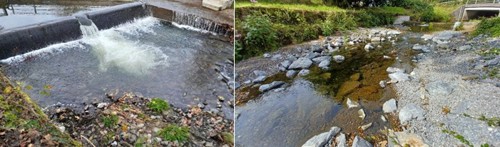
Image: Left to right – Llanwrda Road Bridge before and after work
Llanwrda railway crossing
In October 2024, the LIFE project completed a fish passage easement on a structure under a railway bridge on the Afon Dulais.
Shallow flows over the 14metre long bridge apron, along with a vertical height difference, created a significant barrier to fish migration.
The fish pass comprised of pre-barrages - small dams made from block stone - to raise the water level downstream, thereby reducing the difference in water height (see before and after images below).
A ramp fitted with studded tiles was also fitted through one of the baulks to improve passage for weaker swimming species such as eel and lamprey.
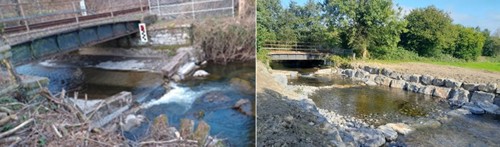
Image: Left to right – Llanwrda railway crossing before and after work
Jerusalem weir on the Afon Clydach
A 2.5m high weir on the Afon Clydach near Llangadog was posing a significant barrier for salmon and other fish trying to reach further upstream to spawn. Jerusalem weir supports the abutments of the historic bridge upstream so removal was not an option.
In summer 2024, a Larinier fish pass was installed (see before and after images below). This type of fish pass reduces flow velocities and, as a result, improves passage of salmon and trout, as well as a range of weaker swimming species.
The design also included a side slot fitted with bristles to help eel move up the river.
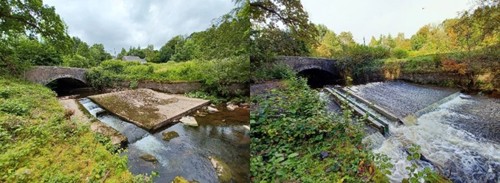
Image: Left to right – Jerusalem weir before and after work
Invasive species work
The Four Rivers for LIFE project has been working to eliminate and reduce the extent of several invasive species on the Tywi, including Himalayan balsam, Japanese knotweed, and Giant Hogweed.
Giant hogweed is a highly invasive species which outgrows native plants and contains a toxic sap which is dangerous to humans and livestock. An infestation has been treated near Manordeilo for several years, and we are close to eliminating it from the Tywi catchment.
Himalayan balsam is extremely widespread in Wales and over-dominates native plants, reducing biodiversity and leaving river banks exposed to erosion when it die back in the winter.
The Four Rivers for LIFE project has been focusing on sub catchments where it is possible to bring down the upstream limit of the plant, namely on the Llandovery Bran and Marlais.
A combination of contractor work and volunteer effort with the West Wales Rivers Trust has helped reduce both extent and abundance of Himalayan balsam in the catchment.
A novel biocontrol method is also being trialled, rust fungus from the Himalayas has been introduced on some sites to test its efficiency in holding back the invasion.
Japanese knotweed is widespread in the Tywi catchment so effort has been limited to eliminating it from active work areas, for example where we have been doing fish passage or fencing works.
Looking ahead
In early 2025 we are hoping to start work with the National Trust on the Dinefwr Floodplain Restoration Project.
With the National Trust we will restore the traditional floodplain features of the Dinefwr Floodplain National Nature Reserve (NNR) and the River Tywi SAC. This includes restoring and enhancing a number of important features such as oxbow lakes, pools, wetland vegetation, the river and the floodplain grassland. This will create a more resilient and biodiverse habitat.
Monitoring by the LIFE project will also continue. Electric fishing surveys will take place on sites where we have completed schemes to monitor the response of the fish community.
Initial results so far include increased salmon fry numbers on the Clydach at most sites upstream of Jerusalem Weir.
The project also hopes to re-establish populations of freshwater pearl mussels and three sites have been selected, with one of these being in the Tywi catchment. We are currently monitoring water quality and fish numbers, and aim to have do a trial release of 200 juvenile mussels in summer 2026.
The Four Rivers for LIFE Project is funded by the EU LIFE Programme with support from Welsh Government and Welsh Water.
To keep up to date with our work you can follow us on Facebook, X (formerly Twitter) and Instagram or subscribe to our newsletter here.